Future-Ready Utilities – Article 2
From Photos to Knowledge: Why Context Matters
By Michael Kay, Chief AI Officer, Remote Intelligence Solutions
Why Context Matters
In the first article of this series, I explored why labeled data is the true foundation of artificial intelligence. The key message was simple: without labeled examples, machines cannot learn.
But there is another question every utility should ask long before AI enters the conversation:
Will today's inspection still make sense five years from now?
That question has very little to do with artificial intelligence. It has everything to do with preserving operational knowledge.
Every inspection captures a moment in time. A technician observes an asset, records its condition, takes photographs, and makes decisions based on years of experience. Unless that information is connected, described, and stored consistently, much of that knowledge begins to disappear the moment the inspection is complete.
The goal of good data management isn't simply to store information. It's to preserve meaning.
The Difference Between Files, Data and Knowledge
Most organizations already have an abundance of inspection files. The challenge isn’t that utilities lack information. It’s that information reaches its full potential when it can be understood in context and connected over time. But files alone are not knowledge. Consider these three stages:
| Stage | What You Have | What You Can Do |
|---|---|---|
| Files | Images, PDFs, reports | Store them |
| Data | Files with consistent metadata | Search and retrieve them |
| Knowledge | Connected inspection history | Compare, understand and improve |
A folder containing one hundred inspection photographs is useful. A system containing one hundred images that are linked to specific assets, inspection dates, locations and observed conditions becomes something far more valuable. It becomes part of the operational memory of the organization.
A Box of Family Photographs
Imagine someone gives you a box containing twenty years of family photographs. The photographs themselves are beautiful, but:
- none have dates
- none identify the people in them
- none explain where they were taken
- some show children
- some show grandparents
- some show holidays.
Without context, much of their meaning has already been lost. Now imagine exactly the same photographs, but with a few simple notes written on the back:
- July 2014
- Lake Tahoe
- Emma's birthday
- Grandfather's last family trip
The photographs haven't changed. The information surrounding them has. Those small pieces of context transform a collection of images into a family history.
Inspection photographs are no different. Utilities face exactly the same challenge. An image of a cracked pole taken today may still exist ten years from now, but unless someone knows which pole, when it was inspected, what was observed, and what happened afterwards, much of its operational value has been lost.
The image survives. The knowledge often doesn’t.
The Evolution of Inspection Data
Inspection technology has evolved rapidly over the past few decades—but the biggest change isn’t the camera. It’s what utilities can reasonably expect to know about their infrastructure.
Years ago, inspections produced relatively few photographs. Film cameras limited both the number of images and the speed with which they became available. Inspectors captured only what they believed was important, and organizations often waited days before photographs could be reviewed.
Digital cameras removed many of those constraints. Inspectors could capture far more images, and they became available almost immediately after returning from the field.
Smartphones accelerated the trend again. Every field technician now carried a capable camera, allowing visual evidence to be captured not only during planned inspections, but during routine maintenance, storm response, and everyday service visits.
Today, drones represent another step change. A single flight can inspect dozens of assets and produce hundreds, or even thousands, of high-resolution images in less time than a traditional ground inspection.
Technology Reduced the Cost of Collecting Information.
The challenge shifted from capture to understanding.
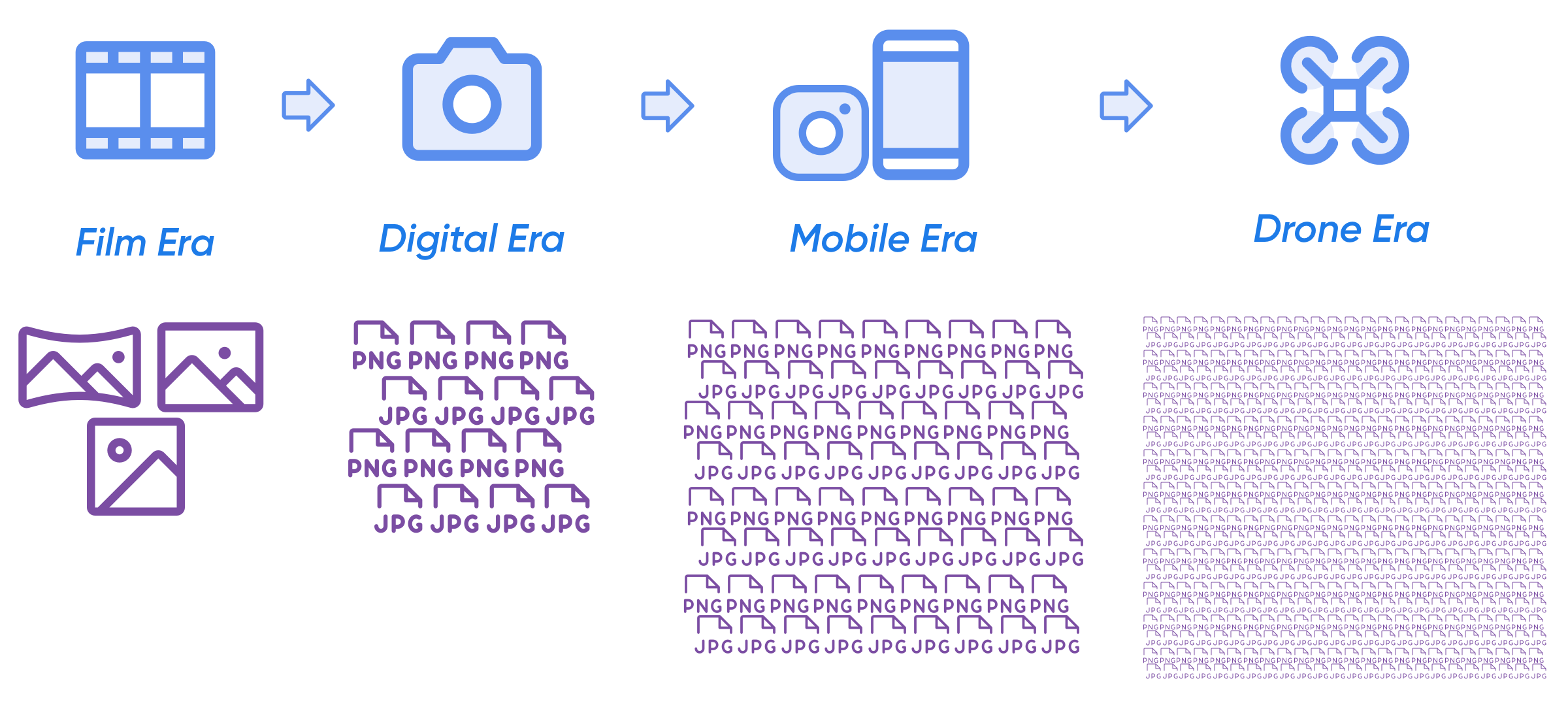
Each technological advance has reduced the cost and time required to collect information. But something else has happened at the same time. Every advance has increased the amount of information that utilities are expected to understand.
The bottleneck has moved. Collecting inspection data is no longer the difficult part. Turning it into timely operational knowledge is.
Today, most utility inspections are driven by regulatory requirements, established maintenance programmes, or events such as severe weather. Those approaches have served the industry well for decades, providing a consistent framework for monitoring network health.
As inspection history becomes richer and better structured, however, utilities may begin to supplement those fixed inspection cycles with additional insight. A combination of observed conditions, historical trends, and engineering judgement may indicate that some assets deserve closer attention long before the next scheduled inspection, while others continue to perform as expected.
This isn’t about replacing regulatory inspection programmes. It’s about using accumulated operational knowledge to make better-informed decisions between those inspection cycles.
Future inspection systems may use historical observations to recommend where additional attention is needed, which components deserve closer examination, or what additional evidence should be collected during the next inspection.
This changes more than the way inspections are performed. It changes what the utility can reasonably expect to know. Instead of documenting a handful of observations, inspections can now capture a far richer picture of the network. That opportunity brings a new responsibility: ensuring that the growing volume of information can still be understood, reviewed, and acted upon.
That future depends on something remarkably simple. Historical inspection data that preserves not only the image, but also its context.
Context Creates Value
Every inspection image answers one question:
What did this asset look like at this moment?
But utilities rarely ask only one question.
They ask questions like:
- Have we seen this before?
- Is this getting worse?
- Has another crew already inspected this pole?
- Is this condition common across the feeder?
- When did this defect first appear?
Those questions cannot be answered by photographs alone. They require context. Context might include a small number of consistent pieces of information, each serving a specific purpose:
| Asset identifier | so the image belongs to the correct asset. |
| GPS location | so it can still be located if asset references change. |
| Inspection date | so changes over time can be understood. |
| Asset type | so similar assets can be compared and analysed together. |
| Component | so observations can be associated with the correct part of the asset, such as the pole, crossarm, insulator, or transformer. |
| Observed condition | so the inspection records not just what was seen, but how it was interpreted by the inspector. |
| Inspection method | so future users understand how the information was collected, whether by ground inspection, drone, climbing inspection, thermal imaging, or another technique. |
Notice that none of these are complicated, yet together they transform isolated observations into reusable knowledge.
Think About Assets, Not Inspections
Many inspection systems naturally organise work around projects.
Spring Storm Assessment
  Pole 1
  Pole 2
  Pole 3
Or around contractors.
Drone Survey May 2026
 - IMG_4021.jpg
 - IMG_4022.jpg
 - IMG_4023.jpg
These structures make sense while the project is active. Five years later they become difficult to navigate. Instead, think from the perspective of the asset: Every inspection should contribute another chapter to that asset's history, not another disconnected collection of files.
This subtle shift changes everything. Instead of asking:
"Where did we store the inspection?"
you begin asking:
"What do we know about this asset?"
Time Turns Observations into Knowledge
A single inspection captures the condition of an asset at one moment in time. That is valuable, but on its own, it rarely tells the whole story. Imagine an inspector photographs a vertical crack in a wooden pole. Should the pole be replaced? Based on a single inspection, it is difficult to answer that question with confidence.
Experienced engineers know there is more to consider. In fact, the USDA Rural Utilities Service's Wood Pole Inspection and Maintenance bulletin recommends evaluating visible defects alongside other evidence such as internal condition, shell thickness, structural capacity, and the results of multiple inspection methods—not isolated observations alone.¹
Has the crack changed since the previous inspection? Is there evidence of decay? Is the pole leaning? Are there signs of insect damage, moisture ingress, or other structural concerns?
The visible crack is one observation. The engineering decision comes from understanding the asset in context.
Now imagine the utility has inspection records spanning the past fifteen years. Perhaps every inspection shows the crack remaining unchanged. That tells one story.
Or perhaps each inspection shows the crack slowly increasing while other indicators—such as moisture, decay, or internal deterioration—also begin to appear. That tells a very different story.
The individual photographs haven't changed. What has changed is the understanding of the asset.
Utilities rarely make asset management decisions based on one observation alone. Guidance from the U.S. Bureau of Reclamation similarly recommends that visible defects such as checks, splits, and cracking should trigger further investigation rather than immediate conclusions, considering additional inspection results before determining the structural condition of a pole.²
¹ USDA Rural Utilities Service. Bulletin 1730B-121 – Wood Pole Inspection and Maintenance
² U.S. Bureau of Reclamation. Facilities Instructions, Standards and Techniques (FIST), Volume 4-6 – Wood Pole Maintenance
A connected series of inspections reveals behaviour.
This is why connecting inspections over time is so important. A single inspection documents the condition of an asset. A connected series of inspections reveals its behaviour.
Engineers are not simply looking for defects—they are looking for patterns, rates of change, and evidence that a condition is stable, improving, or deteriorating. Time transforms individual observations into operational knowledge.
As inspection technologies continue to evolve—from handheld cameras to drones, and eventually to increasingly autonomous inspection systems—that historical knowledge becomes even more valuable.
Today, inspection history helps engineers decide what they need to understand.
Tomorrow, it may also help inspection systems determine what they should look at next.
That future depends on something remarkably simple: Historical inspection data that preserves not only the image—but also its context.
Small Improvements That Make a Big Difference
Improving data structure doesn't require replacing existing systems. Often, small improvements produce significant long-term value. Consider adopting a few simple practices:
- Preserve GPS information captured during inspections.
- Record a consistent asset reference wherever possible.
- Capture a small, agreed set of metadata for every inspection.
- Link images to assets rather than folders.
- Store inspection data where it can be retrieved years later.
- Align with emerging industry taxonomies and naming conventions.
- Preserve the inspection outcome, not just the image.
None of these steps are particularly complicated. Together they ensure today's inspections remain valuable tomorrow.
Better Operations Today
It's tempting to think this is all preparation for artificial intelligence. It isn't. Well-structured inspection data already improves daily operations. Utilities can:
- find previous inspections more quickly,
- support regulatory audits more easily,
- reduce duplicate inspections,
- improve contractor handovers,
- and build a stronger historical understanding of their assets.
Artificial intelligence simply amplifies those benefits later. Good data management delivers value from day one.
A Foundation That Lasts
Infrastructure lasts for decades. Inspection knowledge should last just as long. Every inspection represents an investment—not only in today's operational decisions, but in tomorrow's understanding of the network. As the cost of collecting information continues to fall, the value increasingly comes from preserving the knowledge that surrounds it.
Every well-structured inspection doesn’t simply record the condition of an asset. It adds another observation to a growing body of knowledge about how that asset, and ultimately the network itself, is changing over time.
The organizations that gain the greatest value from inspection programs are rarely those that collect the most data. They're the ones that preserve its meaning.
Today, inspection history helps people understand how an asset has changed over time. In the future, that same history may help determine how the next inspection should be carried out—whether by a person, a drone, or an increasingly autonomous inspection system.
The better the historical context, the better the questions future inspections can ask.
In this article, I focused on how simple structure preserves the meaning of inspection data long after the work has been completed.
In Article 3, Teaching Machines Like Apprentices, I'll explain how those structured inspection records become the examples that allow machine learning systems to recognise patterns, support inspectors, and improve over time.
As it turns out, teaching a machine isn't very different from teaching a new apprentice. Both begin by learning from experienced people. Before machines can learn from inspections, organizations must first ensure that their own knowledge isn’t lost.
Michael V. Kay
Chief AI Officer
Michael Kay brings a strategic approach to leveraging AI for critical infrastructure, drawing on a background in implementing innovative tech within emergency and crisis management. His expertise lies in aligning AI strategies with business goals to drive innovation, efficiency, and measurable outcomes.